
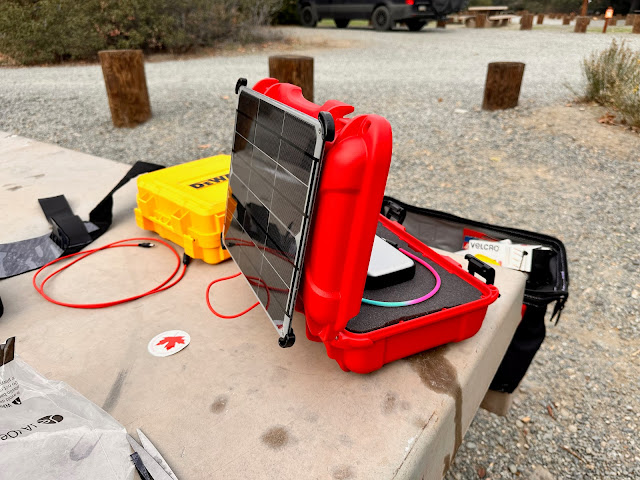
The piece of gear which provoked the most comments during our extended journey down the Mississippi was our solar box. I assembled it from pieces sold by a company called Voltaic with the goal of having something we could just set out on the boat and have it generate power without us having to micromanage it when the weather got bad.
I have always loved the idea of solar but at least so far I've found that the state of technology doesn't really lend itself to being usable on long distance hikes. When you're getting started early and hiking until evening you can't really set a panel out for any length of time during the effective hours of sunlight and putting it on the pack while hiking usually doesn't work real well due to the fact you invariably end up partially shading the panel. And then there's the fact that lighter panels tend to be fragile and even the few folks that I've met who have made it work seem to have had to replace them multiple times. And I'm harder on my gear in general than all those fine folks.

But when we started planning for our Mississippi Source to Sea paddle one of our goals was to avoid the constant need to go into town to charge our hiking batteries. Because it's one thing getting a ride into a hotel when all you have is a backpack and quite another when you have to deal with a 17 ft canoe loaded down with gear. And in fact we only slept in town 6 times over 75 days and when we did indulge it was never driven by the fact we were lower on power.
Since after the headwaters the river is quite wide we didn't have to worry about overhead trees shading the box. And I worked around the fragility issues by using a hard panel vs anything bendable or foldable.

- Posted By: Matthew Hengst
- 0 Comments